> ## Documentation Index
> Fetch the complete documentation index at: https://docs.kaireonai.com/llms.txt
> Use this file to discover all available pages before exploring further.
# Recommend
> Run a tenant's decision flow against one customer and return ranked offers with interactionId and recommendationId for outcome attribution
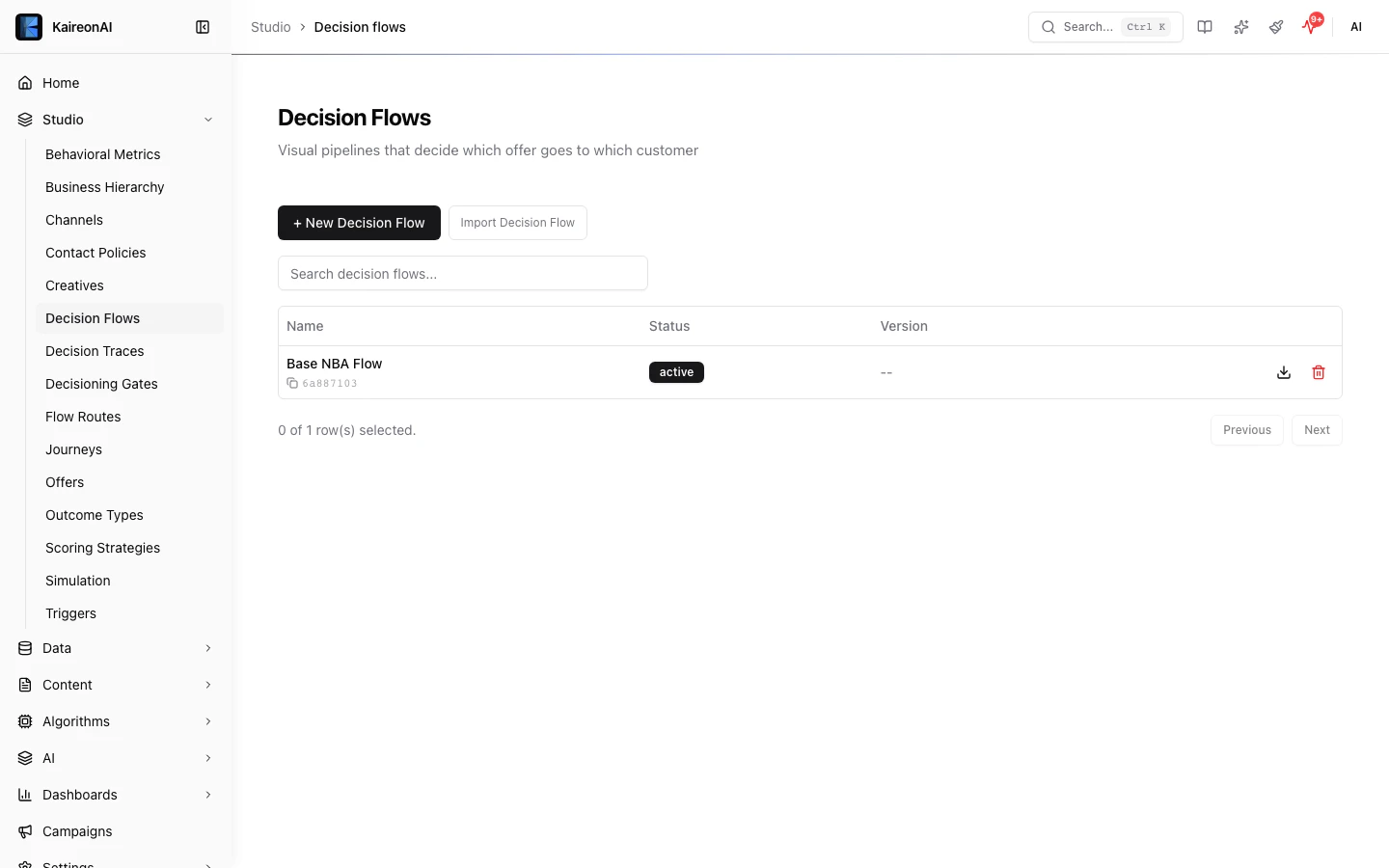 `POST /api/v1/recommend` runs the tenant's published decision flow for one customer and returns a ranked list of offers, each tagged with an `interactionId` and `recommendationId` for downstream attribution. The route is the production hot path for next-best-action delivery.
**Data plane.** This endpoint is part of the public data plane — the runtime
decisioning loop (`/recommend`, `/respond`, `/respond/bulk`, `/capture`) —
and is callable with any `krn_` API key, including default keys minted
without scopes. Management endpoints, by contrast, require control-plane
access (see [API Keys](/api-reference/api-keys)).
## What it does
The route resolves a decision flow for the (tenant, channel, placement) tuple, then hands execution to the decision-flow engine. The engine walks the flow's nodes (Enrich → Qualify → Score → Rank → Compute) and returns the ranked candidates plus a compact trace summary.
Resolution preference is explicit > routed > auto-selected: an explicit `decisionFlowKey` (or legacy `blueprintKey`) wins; if absent, a flow-route lookup keyed by channel and placement runs; if no route matches, the most recently updated published or active flow is picked; if no flows exist, a base flow is lazy-created on the first call.
The route has two synchronous side effects per call. Every returned decision is written to the interaction history as a recommendation row so `POST /api/v1/respond` can look it up by `recommendationId + rank`. Decisions whose channel does not require explicit impression tracking are also auto-recorded as impression rows in the same partitioned table. Both writes use raw SQL because the standard batch-insert path emits an `ON CONFLICT (id)` clause that is invalid against a composite primary key on a partitioned table.
## Quick start
```bash theme={null}
curl -X POST https://playground.kaireonai.com/api/v1/recommend \
-H "Content-Type: application/json" \
-H "X-API-Key: krn_your_api_key" \
-H "X-Tenant-Id: 5a9904b9-..." \
-d '{
"customerId": "cust_42",
"channel": "email",
"placement": "hero_banner",
"limit": 3,
"sessionId": "9b1d-4e6c",
"attributes": { "tier": "gold" },
"locale": "en-US",
"currency": "USD"
}'
```
Response (single-placement shape, abbreviated):
```json theme={null}
{
"interactionId": "f47ac10b-58cc-4372-a567-0e02b2c3d479",
"recommendationId": "f47ac10b-58cc-4372-a567-0e02b2c3d479",
"customerId": "cust_42",
"sessionId": "9b1d-4e6c",
"decisionFlowKey": "main",
"decisionFlowVersion": 7,
"experimentVariant": null,
"controlGroup": false,
"direction": "inbound",
"timestamp": "2026-04-30T14:22:01.123Z",
"channel": "email",
"placement": "hero_banner",
"locale": "en-US",
"currency": "USD",
"count": 3,
"decisions": [
{
"rank": 1,
"score": 0.84,
"offerId": "off_premium_card",
"offerName": "Premium Travel Card",
"channelName": "Email",
"channelType": "email",
"placementId": "plc_hero",
"placementName": "Hero Banner",
"categoryId": "cat_credit",
"categoryName": "Credit Cards",
"subCategory": "Travel",
"mandatory": false,
"priority": 80,
"weight": 100,
"creativeId": "crv_email_a",
"creativeName": "Email Variant A",
"templateType": "html",
"content": "...",
"properties": {},
"abTestVariant": null,
"constraints": {},
"expiresAt": null,
"metadata": {},
"scoreExplanation": {
"method": "priority_weighted",
"priority": 80,
"weight": 100,
"fitMultiplier": 1.0,
"finalScore": 0.84
},
"personalization": { "personalized_rate": 4.99, "greeting": "Welcome back" },
"impressionId": "imp_a3f1..."
}
],
"meta": {
"totalCandidates": 12,
"afterQualification": 8,
"afterSuppression": 8,
"afterContactPolicy": 6,
"degradedScoring": false
}
}
```
## Live sample — captured from playground
The following request and response are **captured verbatim** from the
2026-05-05 functional test against `https://playground.kaireonai.com`,
showing differential propensity scoring for customer C1 (high credit,
short tenure) when the published flow's score node points at
`Scorecard A` (credit-first weights).
```bash theme={null}
curl -X POST 'https://playground.kaireonai.com/api/v1/recommend' \
-H 'Content-Type: application/json' \
-H 'X-API-Key: krn_…' \
-H 'X-Tenant-Id: b25341df-…' \
-d '{
"customerId": "C1",
"channel": "FT Email",
"limit": 3,
"attributes": {
"credit_score": 780,
"tenure_months": 3,
"has_mortgage": false,
"income_band": "high"
}
}'
```
Response:
```json theme={null}
{
"interactionId": "9f12ecaa-…",
"recommendationId": "9f12ecaa-…",
"customerId": "C1",
"channel": "FT Email",
"decisionFlowKey": "base-nba-flow",
"decisionFlowVersion": 31,
"count": 3,
"decisions": [
{
"rank": 1,
"score": 0.9800,
"offerId": "1ca9c6eb-…",
"offerName": "FT Mortgage Refi",
"channelName": "FT Email",
"scoreExplanation": "propensity (Scorecard A)",
"personalization": {}
}
]
}
```
Switching the published flow to `Scorecard B` (loyalty-first weights)
and repeating the same request returns `score: 0.6460` for the same
customer — proving the algorithm swap takes effect end-to-end, per
KaireonAI's internal functional test suite.
## How it works
### Authentication and quota
Every call resolves a tenant before any work runs. Requests carrying an `X-API-Key` that starts with `krn_` are validated against the database and the bound tenant id is used (header `X-Tenant-Id` is ignored to prevent spoofing); other requests fall back to a tenant id read from the request headers. Missing tenant context returns 401; a tenant id that doesn't exist in the database returns 403.
After auth, the handler enforces per-window rate limits and a lifetime decision quota. Playground tenants are capped at 5,000 lifetime decisions; past that the route returns 429 with error code `"PLAYGROUND_QUOTA_EXCEEDED"`. Non-playground tenants face no decision quota.
The rate limiter **fails open on a Redis outage**: if the limiter's backing store is unreachable it cannot count requests, so `/recommend` (and `/respond`) allow the decision through rather than returning `429` — availability is prioritized over strict limiting for the decision plane. Each outage raises a throttled [`rate_limit_degraded`](/operations-reporting/alert-rules#event-injected-metrics) alert so operators are paged. A genuine over-limit with Redis healthy is unaffected and still returns `429`.
### Anonymous-customer derivation
When `customerId` is missing or set to `"anonymous"`, the route derives a stable surrogate. With a `sessionId` present, the surrogate is `anon-{sessionId}` after validating the session id against `^[a-zA-Z0-9_-]+$` and capping at 64 chars. Without a session id, the surrogate is `anon-{8-hex}` derived from an FNV-1a hash of `x-forwarded-for` + `user-agent`. The GET endpoint runs the same derivation.
### Decision-flow resolution
Resolution order:
1. Explicit `decisionFlowKey` (or legacy `blueprintKey`) in the body. If the value is not a key, the route attempts a case-insensitive name lookup and rewrites it to a key.
2. Flow-route lookup keyed by `(tenantId, channelId | channel, placement)`, cached for 120s under `route:{tenantId}:{channelId}:{placement}`.
3. Most recently updated published or active flow.
4. If no flow exists, a base flow is lazy-created on the first call.
If none of these produce a key, the handler returns `400 No published decision flow found.`
### Kill switch and control group
The tenant kill switch reads `tenant.settings.nbaEnabled` and caches the result for 60s under `nba-enabled:{tenantId}`. When the flag is false, the route bypasses flow execution and returns a fallback priority response (offers sorted by `priority` descending, with `nbaEnabled: false` and `meta.fallbackMode = "priority_only"`).
Control-group bucketing runs an FNV-1a hash of `control:{customerId}:{YYYY-MM-DD}` to deterministically bucket the customer for the day. The percentage is read from `tenant.settings.controlGroupPercent` (default 2%, cached 60s under `control-group-pct:{tenantId}`). Control-group decisions keep qualification and contact-policy filtering but get scores randomized via the same hash function so the rank order is independent of the model.
When `explain=true` and the customer is in the control group, each decision's `explanation` labels the randomized score honestly: the propensity factor's reason reads `Control group — score N% is randomized for measurement, not a model prediction` instead of the normal `Model predicts N% response likelihood` narrative, so a randomized score is never presented as a model prediction.
### Engine execution
The engine returns a result envelope with the following shape:
```
{
now: Date,
results: any[],
customerId: string,
decisionFlowId: string,
decisionFlowVersion: number | null,
variantName: string | null,
traceSummary: { totalCandidates, afterQualification, afterSuppression, afterContactPolicy, topScores },
degradedScoring?: boolean,
debugTrace?: { ... } // only when debug is requested
}
```
The per-decision shape is built by the response node. A `scoreExplanation` block is set on every decision and is asserted to be present by the integration test suite. When the candidate was actually scored by a model (rather than plain priority weighting), the response node also carries the scoring engine's own `modelExplanation`/`modelConfidence` through onto the decision — see the field reference below. This is independent of the `explain` query parameter: it's present on every model-scored decision whether or not `explain=true` is set.
### Realtime EXP3-IX bandit
When `tenantSettings.aiAnalyzerSettings.ranking.exp3IxEnabled` is true and arms are configured, the route samples one arm before flow execution. The picked `armIndex` and `armId` thread into the auto-impression's `response` JSON and into the top-level response body. When the flag is off or no arms are configured, the response omits `banditArmIndex`. See [EXP3-IX Ranking](/decisioning/ranking-exp3ix) for arm configuration.
### Side effects
The auto-impression block filters decisions whose channel `impressionMode !== "explicit"` and inserts one impression row per decision via raw SQL. The recommendation-recording block then inserts one recommendation row per decision. Both blocks loop sequentially — N decisions produce up to 2N round-trips against the partitioned interaction-history table. This is intentional: a single batch `INSERT … ON CONFLICT (id) DO NOTHING` cannot be expressed against a composite primary key on a partitioned table.
## Reference
### Request body
The POST body is read field-by-field rather than validated against a single Zod schema. Per-field shape requirements are listed below. The batch endpoint at `/api/v1/recommend/batch` does use a single Zod schema.
Unique customer identifier. When omitted or set to `"anonymous"`, the route derives a stable surrogate from `sessionId` (preferred) or `x-forwarded-for + user-agent`.
Filter candidates to creatives whose channel matches this channel type or name.
Channel ID (UUID) used for flow-route lookup. When supplied, takes precedence over `channel` for routing.
Filter candidates to creatives bound to this placement.
Multi-placement request. Each entry is `{ placementId: string, limit?: number }`. When present, the response is the multi-placement shape and the single-placement fields are omitted.
Multi-placement only. When true, placements are resolved sequentially and each placement excludes offers already returned by earlier placements.
Maximum decisions returned. Clamped to `[1, 50]`.
Session identifier. Used both for anonymous-customer derivation and for echoing back into the response and the auto-impression's `context`. Validated as alphanumeric/`-`/`_`, max 64 chars.
Free-form real-time context (device, page URL, etc.) merged into the auto-impression's `context` JSON.
Customer segment ids passed through to the engine for decisioning gates that match against segments.
Per-request customer attributes. Available to the Compute stage as `attributes.` variables when evaluating computed-field formulas.
Locale code (e.g. `en-US`). Echoed back in the response; reserved for content selection in future stages.
ISO 4217 currency code. Echoed back in the response.
`inbound` or `outbound`. Stored on the recommendation interaction row.
Offer IDs to exclude from candidates. Legacy alias `excludeActions` is also accepted.
Creative IDs to exclude. Legacy alias `excludeTreatments` is also accepted.
Explicit flow key (or name — a case-insensitive name lookup also resolves). Legacy alias `blueprintKey` is also accepted.
When true, the engine attaches a `debugTrace` block (per-rule pass/fail reasons) to the response.
When true, the route adds an `explanation` object to each decision and a `rejectedOffers[]` block built from the debug trace. Implies `debug: true`. `rejectedOffers[]` is **complete**: every pipeline stage that removes a candidate contributes a structured reason, so every offer that entered the pipeline but didn't make the response appears in the list (see the `rejectedOffers` response field below).
### Response (single-placement)
This is the shape returned for both the explicit-key path and the auto-resolve path.
```json theme={null}
{
"interactionId": "uuid",
"recommendationId": "uuid",
"customerId": "cust_42",
"sessionId": "9b1d-4e6c",
"decisionFlowKey": "main",
"decisionFlowVersion": 7,
"experimentVariant": null,
"controlGroup": false,
"direction": "inbound",
"timestamp": "2026-04-30T14:22:01.123Z",
"channel": "email",
"placement": "hero_banner",
"locale": "en-US",
"currency": "USD",
"count": 3,
"decisions": [ /* see decisions[] below */ ],
"banditArmIndex": 2,
"banditArmId": "arm_b",
"meta": {
"totalCandidates": 12,
"afterQualification": 8,
"afterSuppression": 8,
"afterContactPolicy": 6,
"degradedScoring": false,
"negotiationApply": { "applied": 1, "rejected": 0 }
}
}
```
UUID minted at the start of the request. Echoed in the auto-impression's `response.interactionId` and the recommendation row's `response.interactionId`.
Same value as `interactionId`. Use either when calling `POST /api/v1/respond`.
Either the supplied `customerId` or the derived anonymous surrogate.
Echoed back from the request body.
Key of the flow that ran. In the explicit-key path the value reflects the raw request input (after name-to-key translation); in the auto-resolve path it reflects the resolved key.
Version number of the flow's published snapshot, or null when running from a draft configuration.
Variant name when the flow has an experiment node and the customer was assigned a variant.
True when the customer was bucketed into the always-on control group for the current UTC day.
Echoed from the request body, default `"inbound"`.
ISO timestamp from `bpResult.now`, set when the engine started.
Echoed from the `channel` request field, or `"all"` when none was supplied.
Echoed from the `placement` request field, or `"all"` when none was supplied.
Echoed from the request body.
Echoed from the request body.
Number of items in `decisions[]` after the per-request limit was applied.
Ranked offers. See the per-decision sub-fields below.
Present only when `explain=true` and at least one candidate was rejected. Each entry is `{ offerId, offerName?, stage, reason, detail? }` where `stage` is one of `eligibility`, `contact_policy`, `consent`, `channel`, `suppression`, `frequency_cap`, `maturity_ramp`, `guardrail`, `coupling`, or `rank`, `reason` is a self-contained human-readable sentence, and `detail` is an optional structured object (e.g. `exposureProbability`, `capKey`, `scope`). The list is **complete**: every stage that removes a candidate — decisioning gates, contact-policy suppressions and frequency caps, consent, channel/creative/placement filters, suppression rules, the maturity-ramp cold-start floor, hard guardrails, the atomic channel-coupling cascade, and the rank node's topN cut — records an entry, so every offer that entered the pipeline but is absent from `decisions[]` has a stated reason. Example reasons: `"Below cold-start exposure floor — maturity ramp withheld this offer for this customer today (exposure probability 25%, mode bayesian_ci)"`, `"Ranked below the cut — rank node (topN) kept top 2 of 3 candidates (this candidate scored 0.4100)"`. Exact duplicates (same `offerId` + `stage` + `reason`) are emitted once. The same merged list is persisted on `DecisionTrace.rejectedOffers` for sampled traces — see [Decision Traces](/api-reference/decision-traces).
Present only when EXP3-IX is enabled for the tenant AND `tenantSettings.aiAnalyzerSettings.ranking` has configured arms. The route picks one arm before flow execution and threads its index into the response.
Companion to `banditArmIndex`. Echo this value back into `interaction.response` when calling `/respond` so the arm's log-weight gets updated on outcome.
Trace counters from the engine. See sub-fields below.
Number of offers that entered the pipeline.
Candidates remaining after decisioning gates ran.
Candidates remaining after contact policies ran.
Candidates remaining after suppression rules ran. Present in the explicit-key path response; see Honest limits for the auto-resolve path's omission.
True when at least one scorer threw an error and a fallback score was used.
Present only when the realtime negotiation-apply pass ran and produced a non-noop result. Shape: `{ applied: number, rejected: number }`. See [Constraints and Negotiation](/decisioning/constraints-and-negotiation).
Present only when `debug=true` or `explain=true`. Sub-fields: `totalCandidates`,
`afterQualification`, `afterSuppression`, `afterContactPolicy`, `afterConsent`,
`afterGuardrails`, `qualificationReasons[]`, `contactPolicyReasons[]`,
`guardrailReasons[]`, and `rejectionReasons[]`.
The generic per-stage rejection sink: one entry per candidate removed by a
stage that isn't already covered by `qualificationReasons`/`contactPolicyReasons`/`guardrailReasons`
— consent, channel/creative/placement filters, suppression pre-filter,
tenant-wide frequency caps, the maturity-ramp cold-start floor, the atomic
channel-coupling cascade, and the rank node's topN cut. Entry shape:
`{ offerId, offerName?, stage, reason, detail? }`. The response's
`rejectedOffers[]` merges this array with the three legacy reason arrays.
The real candidate count after the guardrail stage removed any `hard`-blocked
candidates. The guardrail stage runs once per request at rank-node entry (or
the response node when a flow has no rank node), so ranking and the result
`limit` operate on the survivors. See
[Guardrails — enforcement](/api-reference/guardrails#enforcement-at-decision-time).
One entry per failed guardrail evaluation:
`{ ruleKey, ruleName, severity: "hard" | "soft", passed: false, reason?, offerId? }`.
A firing `hard` rule blocked its candidate; a firing `soft` rule kept it but
logged a warning.
#### `decisions[]` per-item shape
1-based rank after sorting and any control-group reshuffle.
Final score from the scorer (or randomized in control group).
Joined from `creative.channel.name`.
Joined from `creative.channel.channelType`.
Joined from `creative.placement.name`.
Joined from `offer.categoryRef.name` with fallbacks.
Joined from `offer.subCategoryRef.name` with fallbacks.
Mirrored from `offer.mandatory`.
Mirrored from the candidate's priority (driven by `offer.priority`).
Mirrored from the candidate's weight.
From `creative.templateType`.
From `creative.content`.
Per-candidate property bag from the engine.
From `creative.abTestVariant`.
From `creative.constraints`.
ISO timestamp from `offer.expiresAt`.
From `offer.metadata`.
Set on every decision; the integration test suite asserts it must be present. Shape: `{ method, priority, weight, fitMultiplier, finalScore }`. `method` reflects the scoring method that actually scored this candidate (`priority_weighted`, `propensity`, or `formula`), including per-channel score-node overrides.
Present only when the candidate was scored by an actual model — a `propensity`/`formula`-method score node that resolved a `modelKey` and loaded it successfully. Absent for `priority_weighted` candidates and for a candidate whose scoring fell back after a model-load failure. Shape: `{ engineType: string, details: object[] }`, where `engineType` is the model's `modelType` and the shape of each `details` element depends on the engine. For the default Naive Bayes and regression engines — `bayesian`, `logistic_regression`, `gradient_boosted` (the common case) — each element is `{ field: string, contribution: number }`, sorted by absolute contribution descending, so a caller can see *why* a model-scored offer ranked where it did. `scorecard` models instead return one element per rule evaluated: `{ ruleId, field, operator, expected, actual, matched, points, description? }`. `thompson_bandit` returns `{ offerId, thompsonScore }` per offer in the candidate set.
Present under the same condition as `modelExplanation` — the scoring engine's own confidence value for this candidate's score, carried through from the scorer's result.
Free-form `Record`. Keys are tenant-defined — they come from the category's `customFields` of type `computed`, plus optional flow-level extras and per-flow overrides. Standard examples include `personalized_rate` or `greeting`, but the field set is open.
Present only when the candidate's channel uses implicit impression tracking and the auto-impression insert succeeded. Looked up by deduplication id and threaded into the decision.
Present only when the realtime apply-mode wire ran and the candidate was accepted. Shape: `{ sessionId, proposal }`.
Present only when the realtime apply-mode wire rejected the candidate. Shape: `{ sessionId, reason }`.
### Response (multi-placement)
Returned when the request body supplies a `placements[]` array.
```json theme={null}
{
"placements": {
"hero_banner": {
"offers": [
{
"rank": 1,
"score": 0.84,
"offerId": "off_a",
"offerName": "...",
"creativeId": "crv_x",
"creativeName": "...",
"channelName": "Email",
"categoryName": "Cards",
"mandatory": false,
"priority": 80,
"personalization": {}
}
],
"count": 1
}
},
"customerId": "cust_42",
"interactionId": "uuid",
"recommendationId": "uuid",
"requestId": "uuid",
"timestamp": "2026-04-30T14:22:01.123Z"
}
```
Map of `placementId → { offers: [...], count: number }`. As of the multi-placement fix (#158), each `offers[]` entry includes the same render-essential creative fields as the single-placement shape — specifically `templateType` and `content` — so consumers can render the creative without a follow-up fetch. The fields that remain single-placement-only are `weight`, `scoreExplanation`, `impressionId`, and `appliedNegotiation` (these come from stages that don't fire in the multi-placement code path).
Same value as `interactionId`.
Same value as `interactionId` and `recommendationId`. Multi-placement only — kept for legacy callers that key on `requestId`.
ISO timestamp set when the response was assembled.
Present only when the multi-placement request crossed at least one channel with `couplingMode = "atomic"` (or a `DecisionFlow.couplingOverride = "atomic"`). One entry per channel touched by the request. Shape: `[{ channelId, channelName, mode, cascaded, emptyPlacements: [placementId, ...] }]`. When `cascaded = true`, the channel's other placements were emptied because at least one placement in the same channel had no candidates — surface this in the consumer UI to distinguish "we suppressed this because the sibling was empty" from "this placement just wasn't configured." Cross-channel coupling is intentionally NOT supported; different channels are independent attention surfaces.
### How the multi-placement engine runs the flow
When `placements: [...]` is provided AND every placement resolves to the same decision flow, the recommend route runs `executeDecisionFlow` ONCE with `placementFilters: []`. Flow resolution per placement follows the same explicit > routed > auto order as the single-placement path: an explicit body `decisionFlowKey` applies to **all** placements and beats flow-route lookup; otherwise each placement resolves via `resolveFlowRoute` (channel+placement → channel-only → tenant default). Because an explicit key resolves every placement to the same flow, supplying `decisionFlowKey` always engages the single-flow (Hungarian-across-placements) path. The `match_creatives` node keeps candidates whose `placementId` is in the requested set (plus wildcards when `allowWildcard` is true). The `group` node's allocator (Hungarian or Greedy) sees the full set of slots across all placements in a single cost matrix, so Hungarian enforces per-offer uniqueness across placements within the channel. Each surviving candidate is stamped with its assigned `placementId`, and the route splits the flat result list back into per-placement buckets in the response.
When placements resolve to *different* flows, the route falls back to per-placement execution (one `executeDecisionFlow` call per placement, each scoped to a single placement). In that fallback, Hungarian uniqueness only holds within a single placement; the channel-coupling pass still runs at the route boundary across the aggregated `placementResults`.
### Response (engine-emitted grouped)
Returned when the executed flow's last node is a Group node that emits placements (V2 grouped response).
```json theme={null}
{
"interactionId": "uuid",
"recommendationId": "uuid",
"customerId": "cust_42",
"timestamp": "2026-04-30T14:22:01.123Z",
"placements": { "hero_banner": { "offers": [], "count": 0 } },
"meta": {
"decisionFlowKey": "main",
"decisionFlowVersion": 7,
"experimentVariant": null,
"totalCandidates": 12,
"degradedScoring": false
}
}
```
The engine-emitted grouped response carries a `meta` block; the request-driven multi-placement response (when the caller supplies `placements: [...]`) does not.
### GET endpoint
`GET /api/v1/recommend` accepts a subset of POST body fields as query-string parameters: `customerId`, `channel`, `placement`, `limit`, `decisionFlowKey`, `explain`, `debug`. The GET response omits `sessionId`, `locale`, and `currency` because no request body carries them.
GET records the **same delivery side effects as POST**: it auto-records impression rows for decisions whose channel doesn't use explicit impression tracking, writes one recommendation row per decision, and returns top-level `interactionId` and `recommendationId` (same value). A subsequent `POST /api/v1/respond { recommendationId, rank, outcome }` therefore attributes the outcome and the model learns from GET-served traffic exactly as it does for POST. (Previously GET served offers but wrote no delivery rows, so a later positive `/respond` failed the attribution precondition and returned `recorded_without_adaptation` — GET-driven traffic never closed the learning loop, and frequency caps were blind to it.)
The GET endpoint returns `400 decisionFlowKey is required. Multiple active flows exist: …` when more than one published or active flow exists and no `decisionFlowKey` query parameter is set. POST auto-selects in the same situation.
### Status codes
| Code | When |
| ---- | --------------------------------------------------------------------------- |
| 200 | Successful recommendation |
| 400 | Missing required body fields, invalid JSON, or unresolvable flow |
| 400 | GET only — multiple active flows exist and no `decisionFlowKey` query param |
| 401 | Missing tenant context |
| 403 | Invalid tenant identifier |
| 429 | Rate limit exceeded OR playground 5,000-decision quota exhausted |
| 500 | Unexpected server error |
| 504 | Request exceeded the 30s timeout |
Three different error envelope shapes are emitted by this route:
* Standard API-error envelope — used by 400 and 500: `{ error: { code, message, status, traceId, timestamp } }`.
* Tenant-error envelope — used by 401 and 403: `{ title, detail }`.
* Timeout envelope — `{ error: { code: "TIMEOUT", message: "Request timed out", status: 504 } }`. Omits `traceId` and `timestamp`.
The 429 envelope from the playground quota path is `{ error: { code, message, used, limit } }`; the rate-limiter's 429 envelope is also distinct.
### Required headers
| Header | Required | Purpose |
| ----------------- | -------------------- | --------------------------------------------------------------- |
| `Content-Type` | POST only | `application/json` for POST bodies |
| `X-API-Key` | Yes (one of the two) | API key (`krn_…`) — also used as the rate-limit identifier |
| `X-Tenant-Id` | Yes (one of the two) | Direct tenant id; ignored when `X-API-Key` resolves a tenant |
| `X-Forwarded-For` | No | Falls back to anonymous-id derivation and rate-limit identifier |
| `User-Agent` | No | Used in the FNV-1a hash for anonymous customers |
| `x-user-id` | No | Triggers onboarding-step tracking only |
`Authorization: Bearer …` is **not** a supported authentication mode on this route. The middleware reads the `Authorization` header only to gate CSRF; tenant resolution only verifies `X-API-Key` (when prefixed with `krn_`) and `X-Tenant-Id`.
## Configuration
### Environment variables
| Variable | Effect |
| --------------- | ----------------------------------------- |
| `NODE_ENV=test` | Disables rate limiting in the test runner |
The route does not read any other environment variables directly. Tenant-level behavior is configured through `tenant.settings` and `tenantSettings.aiAnalyzerSettings`.
### Caches
| Cache key | TTL | What it caches |
| ------------------------------------------ | ---- | -------------------------------------------- |
| `route:{tenantId}:{channelId}:{placement}` | 120s | Flow-route resolution by channel + placement |
| `flowkey:{tenantId}:{flowId}` | 120s | Flow id → key lookup |
| `flow:{tenantId}:{flowKey}` | 60s | Compiled decision-flow object |
| `nba-enabled:{tenantId}` | 60s | Tenant kill-switch check |
| `control-group-pct:{tenantId}` | 60s | Control-group percentage |
| `shap-enabled:{tenantId}` | 60s | Whether to compute SHAP in the hot path |
### Rate limits
| Tenant type | Per-window | Window | Lifetime decision quota |
| ----------------------------------------- | ---------- | ------ | ----------------------- |
| Playground (`tenant.isPlayground = true`) | 100 | 60s | 5,000 |
| Non-playground | 1,000 | 60s | None |
Rate-limit identifier preference: `X-API-Key` > `X-Forwarded-For` > `"anonymous"`.
### Request timeout
The POST handler is wrapped in a 30-second request timeout. The GET handler is not wrapped. On timeout the response is `504 { error: { code: "TIMEOUT", message: "Request timed out", status: 504 } }`.
## Honest limits
* The auto-resolve fallthrough response returns a `meta` block that omits `afterSuppression`; the explicit-key path includes all five counters. Tracked as a code-side cleanup.
* Auto-impression and recommendation writes are up to 2N round-trips per request — one raw insert per decision in the impression loop, plus one per decision in the recommendation loop — because the interaction-history table is partitioned and a batch INSERT cannot use `ON CONFLICT (id)` against a composite primary key. A request with `limit=50` produces up to 100 sequential SQL round-trips.
* The POST body is not validated against a single Zod schema. Field validation is per-read in the handler. The batch endpoint at `/api/v1/recommend/batch` does use a single Zod schema.
* `Authorization: Bearer …` is not a supported auth mode. The middleware reads the `Authorization` header only to gate CSRF; tenant resolution only verifies `X-API-Key` and `X-Tenant-Id`.
* The 504 timeout envelope shape diverges from the standard API-error envelope — it omits `traceId` and `timestamp`. The 401/403 envelope uses `{ title, detail }` and is also distinct.
* Bandit arm-index threading fires only when the tenant has EXP3-IX enabled AND configured `banditConfig.arms` in `tenantSettings.aiAnalyzerSettings.ranking`. Without arms it is a structured no-op (no `banditArmIndex` in the response). See [EXP3-IX Ranking](/decisioning/ranking-exp3ix) for arm configuration.
## Related
* [Respond API](/api-reference/respond) — record the outcome of a recommendation.
* [Decision Flows](/decisioning/decision-flows) — the engine that backs this route.
* [Decisioning Gates](/decisioning/qualification-rules) — qualification + contact-policy stages.
* [Ranking Profiles](/api-reference/ranking-profiles) — multi-objective scoring weights.
`POST /api/v1/recommend` runs the tenant's published decision flow for one customer and returns a ranked list of offers, each tagged with an `interactionId` and `recommendationId` for downstream attribution. The route is the production hot path for next-best-action delivery.
**Data plane.** This endpoint is part of the public data plane — the runtime
decisioning loop (`/recommend`, `/respond`, `/respond/bulk`, `/capture`) —
and is callable with any `krn_` API key, including default keys minted
without scopes. Management endpoints, by contrast, require control-plane
access (see [API Keys](/api-reference/api-keys)).
## What it does
The route resolves a decision flow for the (tenant, channel, placement) tuple, then hands execution to the decision-flow engine. The engine walks the flow's nodes (Enrich → Qualify → Score → Rank → Compute) and returns the ranked candidates plus a compact trace summary.
Resolution preference is explicit > routed > auto-selected: an explicit `decisionFlowKey` (or legacy `blueprintKey`) wins; if absent, a flow-route lookup keyed by channel and placement runs; if no route matches, the most recently updated published or active flow is picked; if no flows exist, a base flow is lazy-created on the first call.
The route has two synchronous side effects per call. Every returned decision is written to the interaction history as a recommendation row so `POST /api/v1/respond` can look it up by `recommendationId + rank`. Decisions whose channel does not require explicit impression tracking are also auto-recorded as impression rows in the same partitioned table. Both writes use raw SQL because the standard batch-insert path emits an `ON CONFLICT (id)` clause that is invalid against a composite primary key on a partitioned table.
## Quick start
```bash theme={null}
curl -X POST https://playground.kaireonai.com/api/v1/recommend \
-H "Content-Type: application/json" \
-H "X-API-Key: krn_your_api_key" \
-H "X-Tenant-Id: 5a9904b9-..." \
-d '{
"customerId": "cust_42",
"channel": "email",
"placement": "hero_banner",
"limit": 3,
"sessionId": "9b1d-4e6c",
"attributes": { "tier": "gold" },
"locale": "en-US",
"currency": "USD"
}'
```
Response (single-placement shape, abbreviated):
```json theme={null}
{
"interactionId": "f47ac10b-58cc-4372-a567-0e02b2c3d479",
"recommendationId": "f47ac10b-58cc-4372-a567-0e02b2c3d479",
"customerId": "cust_42",
"sessionId": "9b1d-4e6c",
"decisionFlowKey": "main",
"decisionFlowVersion": 7,
"experimentVariant": null,
"controlGroup": false,
"direction": "inbound",
"timestamp": "2026-04-30T14:22:01.123Z",
"channel": "email",
"placement": "hero_banner",
"locale": "en-US",
"currency": "USD",
"count": 3,
"decisions": [
{
"rank": 1,
"score": 0.84,
"offerId": "off_premium_card",
"offerName": "Premium Travel Card",
"channelName": "Email",
"channelType": "email",
"placementId": "plc_hero",
"placementName": "Hero Banner",
"categoryId": "cat_credit",
"categoryName": "Credit Cards",
"subCategory": "Travel",
"mandatory": false,
"priority": 80,
"weight": 100,
"creativeId": "crv_email_a",
"creativeName": "Email Variant A",
"templateType": "html",
"content": "...",
"properties": {},
"abTestVariant": null,
"constraints": {},
"expiresAt": null,
"metadata": {},
"scoreExplanation": {
"method": "priority_weighted",
"priority": 80,
"weight": 100,
"fitMultiplier": 1.0,
"finalScore": 0.84
},
"personalization": { "personalized_rate": 4.99, "greeting": "Welcome back" },
"impressionId": "imp_a3f1..."
}
],
"meta": {
"totalCandidates": 12,
"afterQualification": 8,
"afterSuppression": 8,
"afterContactPolicy": 6,
"degradedScoring": false
}
}
```
## Live sample — captured from playground
The following request and response are **captured verbatim** from the
2026-05-05 functional test against `https://playground.kaireonai.com`,
showing differential propensity scoring for customer C1 (high credit,
short tenure) when the published flow's score node points at
`Scorecard A` (credit-first weights).
```bash theme={null}
curl -X POST 'https://playground.kaireonai.com/api/v1/recommend' \
-H 'Content-Type: application/json' \
-H 'X-API-Key: krn_…' \
-H 'X-Tenant-Id: b25341df-…' \
-d '{
"customerId": "C1",
"channel": "FT Email",
"limit": 3,
"attributes": {
"credit_score": 780,
"tenure_months": 3,
"has_mortgage": false,
"income_band": "high"
}
}'
```
Response:
```json theme={null}
{
"interactionId": "9f12ecaa-…",
"recommendationId": "9f12ecaa-…",
"customerId": "C1",
"channel": "FT Email",
"decisionFlowKey": "base-nba-flow",
"decisionFlowVersion": 31,
"count": 3,
"decisions": [
{
"rank": 1,
"score": 0.9800,
"offerId": "1ca9c6eb-…",
"offerName": "FT Mortgage Refi",
"channelName": "FT Email",
"scoreExplanation": "propensity (Scorecard A)",
"personalization": {}
}
]
}
```
Switching the published flow to `Scorecard B` (loyalty-first weights)
and repeating the same request returns `score: 0.6460` for the same
customer — proving the algorithm swap takes effect end-to-end, per
KaireonAI's internal functional test suite.
## How it works
### Authentication and quota
Every call resolves a tenant before any work runs. Requests carrying an `X-API-Key` that starts with `krn_` are validated against the database and the bound tenant id is used (header `X-Tenant-Id` is ignored to prevent spoofing); other requests fall back to a tenant id read from the request headers. Missing tenant context returns 401; a tenant id that doesn't exist in the database returns 403.
After auth, the handler enforces per-window rate limits and a lifetime decision quota. Playground tenants are capped at 5,000 lifetime decisions; past that the route returns 429 with error code `"PLAYGROUND_QUOTA_EXCEEDED"`. Non-playground tenants face no decision quota.
The rate limiter **fails open on a Redis outage**: if the limiter's backing store is unreachable it cannot count requests, so `/recommend` (and `/respond`) allow the decision through rather than returning `429` — availability is prioritized over strict limiting for the decision plane. Each outage raises a throttled [`rate_limit_degraded`](/operations-reporting/alert-rules#event-injected-metrics) alert so operators are paged. A genuine over-limit with Redis healthy is unaffected and still returns `429`.
### Anonymous-customer derivation
When `customerId` is missing or set to `"anonymous"`, the route derives a stable surrogate. With a `sessionId` present, the surrogate is `anon-{sessionId}` after validating the session id against `^[a-zA-Z0-9_-]+$` and capping at 64 chars. Without a session id, the surrogate is `anon-{8-hex}` derived from an FNV-1a hash of `x-forwarded-for` + `user-agent`. The GET endpoint runs the same derivation.
### Decision-flow resolution
Resolution order:
1. Explicit `decisionFlowKey` (or legacy `blueprintKey`) in the body. If the value is not a key, the route attempts a case-insensitive name lookup and rewrites it to a key.
2. Flow-route lookup keyed by `(tenantId, channelId | channel, placement)`, cached for 120s under `route:{tenantId}:{channelId}:{placement}`.
3. Most recently updated published or active flow.
4. If no flow exists, a base flow is lazy-created on the first call.
If none of these produce a key, the handler returns `400 No published decision flow found.`
### Kill switch and control group
The tenant kill switch reads `tenant.settings.nbaEnabled` and caches the result for 60s under `nba-enabled:{tenantId}`. When the flag is false, the route bypasses flow execution and returns a fallback priority response (offers sorted by `priority` descending, with `nbaEnabled: false` and `meta.fallbackMode = "priority_only"`).
Control-group bucketing runs an FNV-1a hash of `control:{customerId}:{YYYY-MM-DD}` to deterministically bucket the customer for the day. The percentage is read from `tenant.settings.controlGroupPercent` (default 2%, cached 60s under `control-group-pct:{tenantId}`). Control-group decisions keep qualification and contact-policy filtering but get scores randomized via the same hash function so the rank order is independent of the model.
When `explain=true` and the customer is in the control group, each decision's `explanation` labels the randomized score honestly: the propensity factor's reason reads `Control group — score N% is randomized for measurement, not a model prediction` instead of the normal `Model predicts N% response likelihood` narrative, so a randomized score is never presented as a model prediction.
### Engine execution
The engine returns a result envelope with the following shape:
```
{
now: Date,
results: any[],
customerId: string,
decisionFlowId: string,
decisionFlowVersion: number | null,
variantName: string | null,
traceSummary: { totalCandidates, afterQualification, afterSuppression, afterContactPolicy, topScores },
degradedScoring?: boolean,
debugTrace?: { ... } // only when debug is requested
}
```
The per-decision shape is built by the response node. A `scoreExplanation` block is set on every decision and is asserted to be present by the integration test suite. When the candidate was actually scored by a model (rather than plain priority weighting), the response node also carries the scoring engine's own `modelExplanation`/`modelConfidence` through onto the decision — see the field reference below. This is independent of the `explain` query parameter: it's present on every model-scored decision whether or not `explain=true` is set.
### Realtime EXP3-IX bandit
When `tenantSettings.aiAnalyzerSettings.ranking.exp3IxEnabled` is true and arms are configured, the route samples one arm before flow execution. The picked `armIndex` and `armId` thread into the auto-impression's `response` JSON and into the top-level response body. When the flag is off or no arms are configured, the response omits `banditArmIndex`. See [EXP3-IX Ranking](/decisioning/ranking-exp3ix) for arm configuration.
### Side effects
The auto-impression block filters decisions whose channel `impressionMode !== "explicit"` and inserts one impression row per decision via raw SQL. The recommendation-recording block then inserts one recommendation row per decision. Both blocks loop sequentially — N decisions produce up to 2N round-trips against the partitioned interaction-history table. This is intentional: a single batch `INSERT … ON CONFLICT (id) DO NOTHING` cannot be expressed against a composite primary key on a partitioned table.
## Reference
### Request body
The POST body is read field-by-field rather than validated against a single Zod schema. Per-field shape requirements are listed below. The batch endpoint at `/api/v1/recommend/batch` does use a single Zod schema.
Unique customer identifier. When omitted or set to `"anonymous"`, the route derives a stable surrogate from `sessionId` (preferred) or `x-forwarded-for + user-agent`.
Filter candidates to creatives whose channel matches this channel type or name.
Channel ID (UUID) used for flow-route lookup. When supplied, takes precedence over `channel` for routing.
Filter candidates to creatives bound to this placement.
Multi-placement request. Each entry is `{ placementId: string, limit?: number }`. When present, the response is the multi-placement shape and the single-placement fields are omitted.
Multi-placement only. When true, placements are resolved sequentially and each placement excludes offers already returned by earlier placements.
Maximum decisions returned. Clamped to `[1, 50]`.
Session identifier. Used both for anonymous-customer derivation and for echoing back into the response and the auto-impression's `context`. Validated as alphanumeric/`-`/`_`, max 64 chars.
Free-form real-time context (device, page URL, etc.) merged into the auto-impression's `context` JSON.
Customer segment ids passed through to the engine for decisioning gates that match against segments.
Per-request customer attributes. Available to the Compute stage as `attributes.` variables when evaluating computed-field formulas.
Locale code (e.g. `en-US`). Echoed back in the response; reserved for content selection in future stages.
ISO 4217 currency code. Echoed back in the response.
`inbound` or `outbound`. Stored on the recommendation interaction row.
Offer IDs to exclude from candidates. Legacy alias `excludeActions` is also accepted.
Creative IDs to exclude. Legacy alias `excludeTreatments` is also accepted.
Explicit flow key (or name — a case-insensitive name lookup also resolves). Legacy alias `blueprintKey` is also accepted.
When true, the engine attaches a `debugTrace` block (per-rule pass/fail reasons) to the response.
When true, the route adds an `explanation` object to each decision and a `rejectedOffers[]` block built from the debug trace. Implies `debug: true`. `rejectedOffers[]` is **complete**: every pipeline stage that removes a candidate contributes a structured reason, so every offer that entered the pipeline but didn't make the response appears in the list (see the `rejectedOffers` response field below).
### Response (single-placement)
This is the shape returned for both the explicit-key path and the auto-resolve path.
```json theme={null}
{
"interactionId": "uuid",
"recommendationId": "uuid",
"customerId": "cust_42",
"sessionId": "9b1d-4e6c",
"decisionFlowKey": "main",
"decisionFlowVersion": 7,
"experimentVariant": null,
"controlGroup": false,
"direction": "inbound",
"timestamp": "2026-04-30T14:22:01.123Z",
"channel": "email",
"placement": "hero_banner",
"locale": "en-US",
"currency": "USD",
"count": 3,
"decisions": [ /* see decisions[] below */ ],
"banditArmIndex": 2,
"banditArmId": "arm_b",
"meta": {
"totalCandidates": 12,
"afterQualification": 8,
"afterSuppression": 8,
"afterContactPolicy": 6,
"degradedScoring": false,
"negotiationApply": { "applied": 1, "rejected": 0 }
}
}
```
UUID minted at the start of the request. Echoed in the auto-impression's `response.interactionId` and the recommendation row's `response.interactionId`.
Same value as `interactionId`. Use either when calling `POST /api/v1/respond`.
Either the supplied `customerId` or the derived anonymous surrogate.
Echoed back from the request body.
Key of the flow that ran. In the explicit-key path the value reflects the raw request input (after name-to-key translation); in the auto-resolve path it reflects the resolved key.
Version number of the flow's published snapshot, or null when running from a draft configuration.
Variant name when the flow has an experiment node and the customer was assigned a variant.
True when the customer was bucketed into the always-on control group for the current UTC day.
Echoed from the request body, default `"inbound"`.
ISO timestamp from `bpResult.now`, set when the engine started.
Echoed from the `channel` request field, or `"all"` when none was supplied.
Echoed from the `placement` request field, or `"all"` when none was supplied.
Echoed from the request body.
Echoed from the request body.
Number of items in `decisions[]` after the per-request limit was applied.
Ranked offers. See the per-decision sub-fields below.
Present only when `explain=true` and at least one candidate was rejected. Each entry is `{ offerId, offerName?, stage, reason, detail? }` where `stage` is one of `eligibility`, `contact_policy`, `consent`, `channel`, `suppression`, `frequency_cap`, `maturity_ramp`, `guardrail`, `coupling`, or `rank`, `reason` is a self-contained human-readable sentence, and `detail` is an optional structured object (e.g. `exposureProbability`, `capKey`, `scope`). The list is **complete**: every stage that removes a candidate — decisioning gates, contact-policy suppressions and frequency caps, consent, channel/creative/placement filters, suppression rules, the maturity-ramp cold-start floor, hard guardrails, the atomic channel-coupling cascade, and the rank node's topN cut — records an entry, so every offer that entered the pipeline but is absent from `decisions[]` has a stated reason. Example reasons: `"Below cold-start exposure floor — maturity ramp withheld this offer for this customer today (exposure probability 25%, mode bayesian_ci)"`, `"Ranked below the cut — rank node (topN) kept top 2 of 3 candidates (this candidate scored 0.4100)"`. Exact duplicates (same `offerId` + `stage` + `reason`) are emitted once. The same merged list is persisted on `DecisionTrace.rejectedOffers` for sampled traces — see [Decision Traces](/api-reference/decision-traces).
Present only when EXP3-IX is enabled for the tenant AND `tenantSettings.aiAnalyzerSettings.ranking` has configured arms. The route picks one arm before flow execution and threads its index into the response.
Companion to `banditArmIndex`. Echo this value back into `interaction.response` when calling `/respond` so the arm's log-weight gets updated on outcome.
Trace counters from the engine. See sub-fields below.
Number of offers that entered the pipeline.
Candidates remaining after decisioning gates ran.
Candidates remaining after contact policies ran.
Candidates remaining after suppression rules ran. Present in the explicit-key path response; see Honest limits for the auto-resolve path's omission.
True when at least one scorer threw an error and a fallback score was used.
Present only when the realtime negotiation-apply pass ran and produced a non-noop result. Shape: `{ applied: number, rejected: number }`. See [Constraints and Negotiation](/decisioning/constraints-and-negotiation).
Present only when `debug=true` or `explain=true`. Sub-fields: `totalCandidates`,
`afterQualification`, `afterSuppression`, `afterContactPolicy`, `afterConsent`,
`afterGuardrails`, `qualificationReasons[]`, `contactPolicyReasons[]`,
`guardrailReasons[]`, and `rejectionReasons[]`.
The generic per-stage rejection sink: one entry per candidate removed by a
stage that isn't already covered by `qualificationReasons`/`contactPolicyReasons`/`guardrailReasons`
— consent, channel/creative/placement filters, suppression pre-filter,
tenant-wide frequency caps, the maturity-ramp cold-start floor, the atomic
channel-coupling cascade, and the rank node's topN cut. Entry shape:
`{ offerId, offerName?, stage, reason, detail? }`. The response's
`rejectedOffers[]` merges this array with the three legacy reason arrays.
The real candidate count after the guardrail stage removed any `hard`-blocked
candidates. The guardrail stage runs once per request at rank-node entry (or
the response node when a flow has no rank node), so ranking and the result
`limit` operate on the survivors. See
[Guardrails — enforcement](/api-reference/guardrails#enforcement-at-decision-time).
One entry per failed guardrail evaluation:
`{ ruleKey, ruleName, severity: "hard" | "soft", passed: false, reason?, offerId? }`.
A firing `hard` rule blocked its candidate; a firing `soft` rule kept it but
logged a warning.
#### `decisions[]` per-item shape
1-based rank after sorting and any control-group reshuffle.
Final score from the scorer (or randomized in control group).
Joined from `creative.channel.name`.
Joined from `creative.channel.channelType`.
Joined from `creative.placement.name`.
Joined from `offer.categoryRef.name` with fallbacks.
Joined from `offer.subCategoryRef.name` with fallbacks.
Mirrored from `offer.mandatory`.
Mirrored from the candidate's priority (driven by `offer.priority`).
Mirrored from the candidate's weight.
From `creative.templateType`.
From `creative.content`.
Per-candidate property bag from the engine.
From `creative.abTestVariant`.
From `creative.constraints`.
ISO timestamp from `offer.expiresAt`.
From `offer.metadata`.
Set on every decision; the integration test suite asserts it must be present. Shape: `{ method, priority, weight, fitMultiplier, finalScore }`. `method` reflects the scoring method that actually scored this candidate (`priority_weighted`, `propensity`, or `formula`), including per-channel score-node overrides.
Present only when the candidate was scored by an actual model — a `propensity`/`formula`-method score node that resolved a `modelKey` and loaded it successfully. Absent for `priority_weighted` candidates and for a candidate whose scoring fell back after a model-load failure. Shape: `{ engineType: string, details: object[] }`, where `engineType` is the model's `modelType` and the shape of each `details` element depends on the engine. For the default Naive Bayes and regression engines — `bayesian`, `logistic_regression`, `gradient_boosted` (the common case) — each element is `{ field: string, contribution: number }`, sorted by absolute contribution descending, so a caller can see *why* a model-scored offer ranked where it did. `scorecard` models instead return one element per rule evaluated: `{ ruleId, field, operator, expected, actual, matched, points, description? }`. `thompson_bandit` returns `{ offerId, thompsonScore }` per offer in the candidate set.
Present under the same condition as `modelExplanation` — the scoring engine's own confidence value for this candidate's score, carried through from the scorer's result.
Free-form `Record`. Keys are tenant-defined — they come from the category's `customFields` of type `computed`, plus optional flow-level extras and per-flow overrides. Standard examples include `personalized_rate` or `greeting`, but the field set is open.
Present only when the candidate's channel uses implicit impression tracking and the auto-impression insert succeeded. Looked up by deduplication id and threaded into the decision.
Present only when the realtime apply-mode wire ran and the candidate was accepted. Shape: `{ sessionId, proposal }`.
Present only when the realtime apply-mode wire rejected the candidate. Shape: `{ sessionId, reason }`.
### Response (multi-placement)
Returned when the request body supplies a `placements[]` array.
```json theme={null}
{
"placements": {
"hero_banner": {
"offers": [
{
"rank": 1,
"score": 0.84,
"offerId": "off_a",
"offerName": "...",
"creativeId": "crv_x",
"creativeName": "...",
"channelName": "Email",
"categoryName": "Cards",
"mandatory": false,
"priority": 80,
"personalization": {}
}
],
"count": 1
}
},
"customerId": "cust_42",
"interactionId": "uuid",
"recommendationId": "uuid",
"requestId": "uuid",
"timestamp": "2026-04-30T14:22:01.123Z"
}
```
Map of `placementId → { offers: [...], count: number }`. As of the multi-placement fix (#158), each `offers[]` entry includes the same render-essential creative fields as the single-placement shape — specifically `templateType` and `content` — so consumers can render the creative without a follow-up fetch. The fields that remain single-placement-only are `weight`, `scoreExplanation`, `impressionId`, and `appliedNegotiation` (these come from stages that don't fire in the multi-placement code path).
Same value as `interactionId`.
Same value as `interactionId` and `recommendationId`. Multi-placement only — kept for legacy callers that key on `requestId`.
ISO timestamp set when the response was assembled.
Present only when the multi-placement request crossed at least one channel with `couplingMode = "atomic"` (or a `DecisionFlow.couplingOverride = "atomic"`). One entry per channel touched by the request. Shape: `[{ channelId, channelName, mode, cascaded, emptyPlacements: [placementId, ...] }]`. When `cascaded = true`, the channel's other placements were emptied because at least one placement in the same channel had no candidates — surface this in the consumer UI to distinguish "we suppressed this because the sibling was empty" from "this placement just wasn't configured." Cross-channel coupling is intentionally NOT supported; different channels are independent attention surfaces.
### How the multi-placement engine runs the flow
When `placements: [...]` is provided AND every placement resolves to the same decision flow, the recommend route runs `executeDecisionFlow` ONCE with `placementFilters: []`. Flow resolution per placement follows the same explicit > routed > auto order as the single-placement path: an explicit body `decisionFlowKey` applies to **all** placements and beats flow-route lookup; otherwise each placement resolves via `resolveFlowRoute` (channel+placement → channel-only → tenant default). Because an explicit key resolves every placement to the same flow, supplying `decisionFlowKey` always engages the single-flow (Hungarian-across-placements) path. The `match_creatives` node keeps candidates whose `placementId` is in the requested set (plus wildcards when `allowWildcard` is true). The `group` node's allocator (Hungarian or Greedy) sees the full set of slots across all placements in a single cost matrix, so Hungarian enforces per-offer uniqueness across placements within the channel. Each surviving candidate is stamped with its assigned `placementId`, and the route splits the flat result list back into per-placement buckets in the response.
When placements resolve to *different* flows, the route falls back to per-placement execution (one `executeDecisionFlow` call per placement, each scoped to a single placement). In that fallback, Hungarian uniqueness only holds within a single placement; the channel-coupling pass still runs at the route boundary across the aggregated `placementResults`.
### Response (engine-emitted grouped)
Returned when the executed flow's last node is a Group node that emits placements (V2 grouped response).
```json theme={null}
{
"interactionId": "uuid",
"recommendationId": "uuid",
"customerId": "cust_42",
"timestamp": "2026-04-30T14:22:01.123Z",
"placements": { "hero_banner": { "offers": [], "count": 0 } },
"meta": {
"decisionFlowKey": "main",
"decisionFlowVersion": 7,
"experimentVariant": null,
"totalCandidates": 12,
"degradedScoring": false
}
}
```
The engine-emitted grouped response carries a `meta` block; the request-driven multi-placement response (when the caller supplies `placements: [...]`) does not.
### GET endpoint
`GET /api/v1/recommend` accepts a subset of POST body fields as query-string parameters: `customerId`, `channel`, `placement`, `limit`, `decisionFlowKey`, `explain`, `debug`. The GET response omits `sessionId`, `locale`, and `currency` because no request body carries them.
GET records the **same delivery side effects as POST**: it auto-records impression rows for decisions whose channel doesn't use explicit impression tracking, writes one recommendation row per decision, and returns top-level `interactionId` and `recommendationId` (same value). A subsequent `POST /api/v1/respond { recommendationId, rank, outcome }` therefore attributes the outcome and the model learns from GET-served traffic exactly as it does for POST. (Previously GET served offers but wrote no delivery rows, so a later positive `/respond` failed the attribution precondition and returned `recorded_without_adaptation` — GET-driven traffic never closed the learning loop, and frequency caps were blind to it.)
The GET endpoint returns `400 decisionFlowKey is required. Multiple active flows exist: …` when more than one published or active flow exists and no `decisionFlowKey` query parameter is set. POST auto-selects in the same situation.
### Status codes
| Code | When |
| ---- | --------------------------------------------------------------------------- |
| 200 | Successful recommendation |
| 400 | Missing required body fields, invalid JSON, or unresolvable flow |
| 400 | GET only — multiple active flows exist and no `decisionFlowKey` query param |
| 401 | Missing tenant context |
| 403 | Invalid tenant identifier |
| 429 | Rate limit exceeded OR playground 5,000-decision quota exhausted |
| 500 | Unexpected server error |
| 504 | Request exceeded the 30s timeout |
Three different error envelope shapes are emitted by this route:
* Standard API-error envelope — used by 400 and 500: `{ error: { code, message, status, traceId, timestamp } }`.
* Tenant-error envelope — used by 401 and 403: `{ title, detail }`.
* Timeout envelope — `{ error: { code: "TIMEOUT", message: "Request timed out", status: 504 } }`. Omits `traceId` and `timestamp`.
The 429 envelope from the playground quota path is `{ error: { code, message, used, limit } }`; the rate-limiter's 429 envelope is also distinct.
### Required headers
| Header | Required | Purpose |
| ----------------- | -------------------- | --------------------------------------------------------------- |
| `Content-Type` | POST only | `application/json` for POST bodies |
| `X-API-Key` | Yes (one of the two) | API key (`krn_…`) — also used as the rate-limit identifier |
| `X-Tenant-Id` | Yes (one of the two) | Direct tenant id; ignored when `X-API-Key` resolves a tenant |
| `X-Forwarded-For` | No | Falls back to anonymous-id derivation and rate-limit identifier |
| `User-Agent` | No | Used in the FNV-1a hash for anonymous customers |
| `x-user-id` | No | Triggers onboarding-step tracking only |
`Authorization: Bearer …` is **not** a supported authentication mode on this route. The middleware reads the `Authorization` header only to gate CSRF; tenant resolution only verifies `X-API-Key` (when prefixed with `krn_`) and `X-Tenant-Id`.
## Configuration
### Environment variables
| Variable | Effect |
| --------------- | ----------------------------------------- |
| `NODE_ENV=test` | Disables rate limiting in the test runner |
The route does not read any other environment variables directly. Tenant-level behavior is configured through `tenant.settings` and `tenantSettings.aiAnalyzerSettings`.
### Caches
| Cache key | TTL | What it caches |
| ------------------------------------------ | ---- | -------------------------------------------- |
| `route:{tenantId}:{channelId}:{placement}` | 120s | Flow-route resolution by channel + placement |
| `flowkey:{tenantId}:{flowId}` | 120s | Flow id → key lookup |
| `flow:{tenantId}:{flowKey}` | 60s | Compiled decision-flow object |
| `nba-enabled:{tenantId}` | 60s | Tenant kill-switch check |
| `control-group-pct:{tenantId}` | 60s | Control-group percentage |
| `shap-enabled:{tenantId}` | 60s | Whether to compute SHAP in the hot path |
### Rate limits
| Tenant type | Per-window | Window | Lifetime decision quota |
| ----------------------------------------- | ---------- | ------ | ----------------------- |
| Playground (`tenant.isPlayground = true`) | 100 | 60s | 5,000 |
| Non-playground | 1,000 | 60s | None |
Rate-limit identifier preference: `X-API-Key` > `X-Forwarded-For` > `"anonymous"`.
### Request timeout
The POST handler is wrapped in a 30-second request timeout. The GET handler is not wrapped. On timeout the response is `504 { error: { code: "TIMEOUT", message: "Request timed out", status: 504 } }`.
## Honest limits
* The auto-resolve fallthrough response returns a `meta` block that omits `afterSuppression`; the explicit-key path includes all five counters. Tracked as a code-side cleanup.
* Auto-impression and recommendation writes are up to 2N round-trips per request — one raw insert per decision in the impression loop, plus one per decision in the recommendation loop — because the interaction-history table is partitioned and a batch INSERT cannot use `ON CONFLICT (id)` against a composite primary key. A request with `limit=50` produces up to 100 sequential SQL round-trips.
* The POST body is not validated against a single Zod schema. Field validation is per-read in the handler. The batch endpoint at `/api/v1/recommend/batch` does use a single Zod schema.
* `Authorization: Bearer …` is not a supported auth mode. The middleware reads the `Authorization` header only to gate CSRF; tenant resolution only verifies `X-API-Key` and `X-Tenant-Id`.
* The 504 timeout envelope shape diverges from the standard API-error envelope — it omits `traceId` and `timestamp`. The 401/403 envelope uses `{ title, detail }` and is also distinct.
* Bandit arm-index threading fires only when the tenant has EXP3-IX enabled AND configured `banditConfig.arms` in `tenantSettings.aiAnalyzerSettings.ranking`. Without arms it is a structured no-op (no `banditArmIndex` in the response). See [EXP3-IX Ranking](/decisioning/ranking-exp3ix) for arm configuration.
## Related
* [Respond API](/api-reference/respond) — record the outcome of a recommendation.
* [Decision Flows](/decisioning/decision-flows) — the engine that backs this route.
* [Decisioning Gates](/decisioning/qualification-rules) — qualification + contact-policy stages.
* [Ranking Profiles](/api-reference/ranking-profiles) — multi-objective scoring weights.